
How Kids Ages 8–15 Can Learn Coding: Why Starting with Python Today Can Shape Their Tomorrow
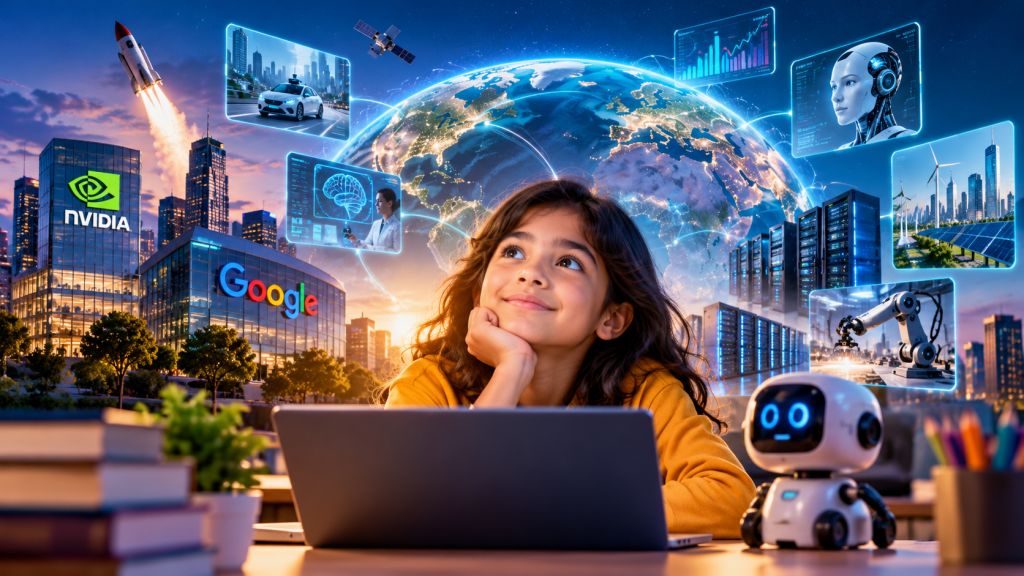
The world is moving at an unprecedented pace toward artificial intelligence, automation, and deep technology. Tech giants like Nvidia, Databricks, Amazon, and Google are building the foundational infrastructure of tomorrow, and their ecosystems rely heavily on programming languages like Python.
As a parent, you likely look at your child easily navigating smartphones, games, and AI tools and wonder: Are we preparing them merely to use these technologies—or to understand and build them?
Knowing how to use technology is completely different from knowing how to create it. For children aged 8 to 15, coding for kids is no longer just an optional extracurricular activity or a resume booster; it is an opportunity to develop the logical thinking, problem-solving abilities, and technical literacy needed for the future.
The Deep Tech Revolution: Why Coding & AI Are the New Literacy
We are living through a massive technological shift driven by artificial intelligence, automation, and advanced engineering. Industry leaders and innovation pioneers are completely transforming how the modern world operates.
- Nvidia is advancing accelerated computing, AI infrastructure, and robotics, relying on developer ecosystems built around Python and C++ tools.
- Databricks enables developers to work with massive datasets and build sophisticated AI applications using versatile programming languages.
- Amazon Web Services (AWS) continues to invest heavily in cloud infrastructure and AI developer tools.
- Google builds state-of-the-art multimodal AI models like Gemini and AI-assisted development experiences.
All of these industry movements reflect a single undeniable reality: sophisticated modern technology depends entirely on people who can design systems, reason through complex problems, and understand code. Startups everywhere are building AI-enabled healthcare systems, cybersecurity tools, scientific discovery platforms, and robotic automation.
According to projections by the US Bureau of Labor Statistics, software engineering and developer roles will experience strong, continued growth over the decade from 2024 to 2034.
While AI can now generate and debug code, human logical thinking, strategic problem-solving, and the ability to evaluate, test, and improve AI-generated results have become more valuable than ever. The future belongs not just to people who use AI, but to people who can question it, guide it, and build with it.
The Deep Tech Revolution: Why Coding & AI Are the New Literacy
We are living through a massive technological shift driven by artificial intelligence, automation, and advanced engineering. Industry leaders and innovation pioneers are completely transforming how the modern world operates.
- Nvidia is advancing accelerated computing, AI infrastructure, and robotics, relying on developer ecosystems built around Python and C++ tools.
- Databricks enables developers to work with massive datasets and build sophisticated AI applications using versatile programming languages.
- Amazon Web Services (AWS) continues to invest heavily in cloud infrastructure and AI developer tools.
- Google builds state-of-the-art multimodal AI models like Gemini and AI-assisted development experiences.
All of these industry movements reflect a single undeniable reality: sophisticated modern technology depends entirely on people who can design systems, reason through complex problems, and understand code. Startups everywhere are building AI-enabled healthcare systems, cybersecurity tools, scientific discovery platforms, and robotic automation.
According to projections by the US Bureau of Labor Statistics, software engineering and developer roles will experience strong, continued growth over the decade from 2024 to 2034.
While AI can now generate and debug code, human logical thinking, strategic problem-solving, and the ability to evaluate, test, and improve AI-generated results have become more valuable than ever. The future belongs not just to people who use AI, but to people who can question it, guide it, and build with it.
The Graduate Gap vs. The Early Learning Advantage
Why Fresh Graduates Struggle in Today’s Fast-Moving Tech Sector?
Every year, thousands of computer science graduates enter the job market only to discover they struggle to keep pace with rapid technological evolution:
The Rote-Learning Trap: Many university students study programming strictly to clear exams, achieve high marks, or secure immediate entry-level employment, leaving them with fragile problem-solving logic.
Syntax vs. Logic: Memorizing code snippets without understanding core computational logic means they freeze when a new framework or tool emerges.
The Career Pressure Burden: Trying to learn complex architectural systems under the intense pressure of immediate job hunting and career timelines creates massive anxiety.
The Advantage of Learning Young (Ages 8 to 15 / Grades 4 to 10)
Imagine a college student learning coding under job-interview pressure and a 10-year-old building a guessing game out of curiosity. Both can learn well. The younger learner, however, may have more freedom to experiment, make mistakes, and revise an idea simply because it is interesting.
Introducing coding for students at an early age allows children to develop programming fundamentals gradually, without the immediate pressure of professional outcomes. Whether through beginner coding activities or Python coding for teens, early exposure can create opportunities to develop curiosity, logical reasoning, and technical confidence.
Zero Career Pressure: Children learn out of pure curiosity, creativity, and play, allowing them to absorb concepts organically without stress.
Strong Computational Logic: Syntaxes change across different tools and eras, but core problem-solving logic remains the same. Early exposure helps develop mental frameworks that can support future learning.
Unshakable Confidence: Early mastery can reduce intimidation around technology, transforming kids from passive consumers into confident digital creators.
Starting early does not guarantee a technology career, nor should coding become another source of pressure. The real opportunity is to develop useful ways of thinking at an age when exploration can be joyful.
Programming Languages Change. The Logic Remains Transferable.
Programming languages have different syntax, libraries, and capabilities. Yet core concepts—variables, conditions, loops, functions, and breaking down problems—carry across many languages.
For example, deciding whether a test score qualifies as “Passed” requires the same underlying conditional logic in Python and JavaScript, even though the punctuation and wording differ. Syntax changes; reasoning transfers.
A learner who understands why code works is better equipped to move between languages than someone who has only memorized commands. New languages still require practice, but a strong foundation makes the next step easier.
Why Python Is the Ideal First Language for Kids
When parents search for coding classes for kids, coding for beginners, or suitable Python coding courses, they encounter options like Scratch, JavaScript, C++, and Python.
While visual blocks have their place, Python stands out as an excellent launchpad for text-based programming and future deep tech integration:
Beginner-friendly syntax: Readable code lets students experiment without too much initial complexity.
Real-world versatility: Python is used in automation, scientific computing, web development, data analysis, and AI.
A pathway to deep tech: Ecosystems such as PyTorch allow learners to explore machine learning later.
Practical projects: Students can progress from simple quizzes and Python coding games to larger applications.
Python is not the only good first language; it balances accessibility with significant long-term possibilities.
For parents comparing Python coding courses, the key is to choose a program that emphasizes programming logic, hands-on learning, and real understanding rather than simply memorizing syntax.
Core Benefits of Learning Python Young
Introducing children to Python coding classes yields advantages that extend far beyond the computer screen:
Enhanced Problem-Solving & Critical Thinking: Teaches kids how to break massive, complex problems down into manageable, logical steps.
Purposeful Screen Time: Shifts children from passive consumers of video games and apps into active creators who understand how software works. Through hands-on projects and Python coding games, children can turn screen time into meaningful learning experiences.
Competitions & Challenges: Empowers kids to participate in age-appropriate hackathons, school clubs, and coding challenges with growing confidence.
Academic & Future Readiness: Builds independent thinking and a project portfolio that demonstrates initiative, curiosity, and forward-thinking capability.
How Can an 8 to 15-Year-Old Actually Start?
A structured, progressive roadmap ensures kids don’t feel overwhelmed while mastering text-based programming. Beginner-friendly Python programming lessons and practical Python coding lessons can help children develop their skills one concept at a time.
Begin with Logical Thinking: Introduce everyday algorithms, sequences, patterns, and cause-and-effect reasoning.
Learn Python Fundamentals: Grasp print statements, user input, variables, conditions, loops, and functions.
Build Small Projects: Create interactive quizzes, simple calculators, and text-based guessing games.
Practice Independent Debugging: Learn to read error messages, test assumptions, and modify programs without following a tutorial word-for-word.
Progress to Advanced Applications: Move into data structures, automation, data analysis, and introductory AI concepts.
The objective is not to rush children through multiple programming concepts, but to help them develop a strong foundation that supports increasingly complex learning.
Are Online Coding Classes Effective for Kids?
Parents looking to help their children learn coding online have access to a wide range of educational resources, including recorded tutorials, self-paced courses, and live instructor-led programs.
Online coding classes can be remarkably effective when they offer real-time interaction, structured guidance, hands-on projects, and constructive feedback instead of passive video watching.
When comparing online coding classes for kids or online Python lessons, parents should look for programs where children can explain their projects, change code independently, and debug simple problems with expert mentorship.
Well-structured online Python coding classes should focus on helping students understand the logic behind programming rather than merely completing lessons.
For younger beginners and teens alike, the right learning environment can make coding more accessible, engaging, and rewarding.
Learn Python with : From Fundamentals to Real-World Mastery
At {igebra.ai}, children learn far more than just how to type code. They learn to think logically, approach problems confidently, and understand the deep technology shaping the world around them.
The Coding4AI program offers live online Python coding classes tailored specifically for students in Grades 4 to 10 (Ages 8 to 15).
Whether your child is taking their first steps into programming or looking to develop more advanced skills, the program offers a structured pathway from Python fundamentals toward AI applications.
Live Instructor-Led Classes: Real-time online sessions conducted in small grade-wise batches to ensure personalized attention and active student engagement.
From Basics to AI Mastery: A level-based curriculum moving seamlessly from Python foundations into machine learning, deep learning, and real-world AI applications.
Hands-on AI Projects: Students build functional chatbots, image recognition tools, and data-driven software applications.
Complete Learning Support: High-quality video backups for anytime revision, regular practice assignments, supplementary support classes, and periodic parent-teacher meetings (PTMs) to track progress.
Your child already knows how to use technology. Help them learn how to build it.
Explore Coding4AI at https://www.igebra.ai/courses/coding4ai/
Final Thoughts: Build a Foundation Before It Becomes a Necessity
Nobody can predict precisely which programming languages, frameworks, or AI platforms will dominate the tech landscape a decade from now. What we can do is equip children with the timeless cognitive tools they need to adapt: logical reasoning, fearless problem-solving, curiosity, and creative self-expression.
An eight-year-old exploring Python today does not need to worry about career pathways or job titles. They simply need a joyful, engaging environment to tinker, experiment, and think.
The true superpower of learning code young isn’t getting a head start on an industry resume—it is gaining the confidence and mental foundation to build whatever future their imagination inspires.
And that remarkable journey can begin today with a single, simple line of Python.
Frequently Asked Questions (FAQ)
Q1. Is 8 years old too young to start learning Python?
Not at all. With interactive guidance and age-appropriate teaching methods, children as young as eight can start learning Python through simple commands, logical activities, and fun projects. Beginner-friendly online Python classes for kids can help young learners develop coding fundamentals gradually.
Q2. Is Python better than Scratch for kids?
Both serve different purposes. Scratch introduces programming logic using visual blocks, while Python introduces text-based coding. Many children transition smoothly from Scratch to Python as their understanding and confidence develop.
Q3. Can a child learn Python without any prior coding experience?
Yes! Beginner Python coding courses for kids start with basic programming concepts and gradually introduce variables, conditions, loops, and functions. No previous coding experience is required.
Q4. How long does it take a child to learn Python?
Children can begin creating simple programs and games within their first few lessons. However, developing strong programming skills requires consistent practice, hands-on projects, and structured learning over time.
Q5. Will coding improve school performance?
Coding creates opportunities to practice logical reasoning, structured problem-solving, and mathematical concepts. These skills can complement classroom learning, although improvements in academic performance are not guaranteed.
Q6. Is coding worth learning when AI can already write code?
Absolutely. Understanding programming helps children evaluate AI-generated code, identify logical errors, and independently solve problems. Strong coding fundamentals also prepare children to explore advanced technologies such as machine learning and AI.
Q7. Can Python help with college admissions?
Meaningful coding projects, hackathon participation, and sustained STEM involvement can demonstrate initiative, curiosity, and technical interest. However, college admission depends on many factors beyond coding skills.
Q8. What are the best online Python coding classes for kids in the USA?
The best online Python coding classes for kids in the USA combine live instruction, structured curricula, hands-on projects, and personalized feedback. Parents should look for programs that develop logical thinking and independent problem-solving rather than focusing only on syntax.
{igebra.ai}’s Coding4AI program offers live online Python lessons for students in Grades 4–10, with a progressive learning pathway from beginner programming to AI concepts.
Q9. Can middle school students learn Python coding online?
Yes. Online Python coding classes for middle school students can introduce functions, algorithms, debugging, and project-based programming. With structured guidance, students can gradually progress toward more advanced applications.
Q10. Are live online Python coding classes better than recorded courses?
Both formats have benefits. However, live online Python coding classes for kids provide opportunities to ask questions, receive immediate feedback, collaborate, and work through challenges with instructor guidance. This can be particularly helpful for beginners who need additional support.